



-
Regular price Rs.10,591Sale price Rs.10,591 Regular priceUnit price per
Ships in 5-6 days.
Get it by Thu, Sep 10 – Fri, Sep 11
-
Regular price Rs.8,584Sale price Rs.8,584 Regular priceUnit price per
Ships in 5-6 days.
Get it by Thu, Sep 10 – Fri, Sep 11
-
Regular price Rs.2,133Sale price Rs.2,133 Regular priceUnit price per
Ships in 5-6 days.
Get it by Thu, Sep 10 – Fri, Sep 11
-
Regular price Rs.4,268Sale price Rs.4,268 Regular priceUnit price per
Ships in 5-6 days.
Get it by Thu, Sep 10 – Fri, Sep 11
-
Regular price Rs.5,186Sale price Rs.5,186 Regular priceUnit price per
Ships in 5-6 days.
Get it by Thu, Sep 10 – Fri, Sep 11
-
Regular price Rs.12,042Sale price Rs.12,042 Regular priceUnit price per
Ships in 5-6 days.
Get it by Thu, Sep 10 – Fri, Sep 11
-
Regular price Rs.8,373Sale price Rs.8,373 Regular priceUnit price per
Ships in 5-6 days.
Get it by Thu, Sep 10 – Fri, Sep 11
-
Regular price Rs.6,924Sale price Rs.6,924 Regular priceUnit price per
Ships in 5-6 days.
Get it by Thu, Sep 10 – Fri, Sep 11
-
Regular price Rs.8,083Sale price Rs.8,083 Regular priceUnit price per
Ships in 5-6 days.
Get it by Thu, Sep 10 – Fri, Sep 11
-
Regular price Rs.5,880Sale price Rs.5,880 Regular priceUnit price per
Ships in 5-6 days.
Get it by Thu, Sep 10 – Fri, Sep 11
-
Regular price Rs.7,677Sale price Rs.7,677 Regular priceUnit price per
Ships in 5-6 days.
Get it by Thu, Sep 10 – Fri, Sep 11
-
Regular price Rs.13,058Sale price Rs.13,058 Regular priceUnit price per
Ships in 5-6 days.
Get it by Thu, Sep 10 – Fri, Sep 11







Kurta Pyjama for Boys: The Complete Guide to Dressing Your Son in Style for Every Occasion
There is a particular kind of pride that comes with seeing a little boy in a well-fitted kurta pyjama. It is not the forced formality of a tiny suit and tie. It is something more natural, more rooted, and more genuinely festive. A kurta pyjama for boys is the ethnic-wear equivalent of coming home. It fits the occasion, the culture, and, when made well, the child perfectly.
This guide covers everything parents need to know about choosing, styling, and caring for kurta pyjamas for boys, from toddlers attending their first family wedding to teenagers going to a festive puja.
The History of the Kurta Pyjama and Why It Still Matters
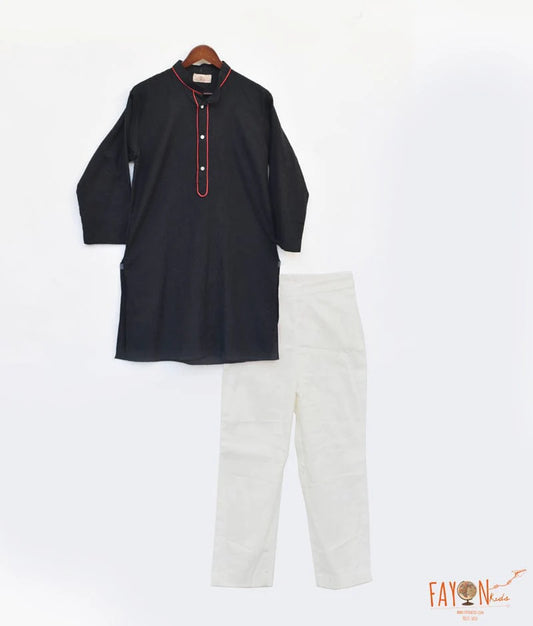
The kurta pyjama has been the foundational garment of Indian men's ethnic wear for centuries. In its simplest form, it is a long tunic (the kurta) paired with a relaxed, straight-legged trouser (the pyjama). Over centuries, regional variations have emerged. The Lucknowi kurta with its chikankari embroidery, the Punjabi kurta with its bold colours and minimal cuts, and the formal sherwani-inspired kurta with heavy embroidery and structured fabric are all descendants of the same basic garment.
For children, the kurta pyjama has remained the go-to ethnic outfit precisely because of its simplicity and versatility. Unlike a sherwani, which is formal and restrictive, a well-made kurta pyjama allows children to move freely. Unlike Western formal wear, it requires no tie, no belt, and no stiff collar that a child will immediately pull at.
Types of Kurta Pyjama for Boys
Understanding the different styles available helps parents make the right choice for the right occasion.
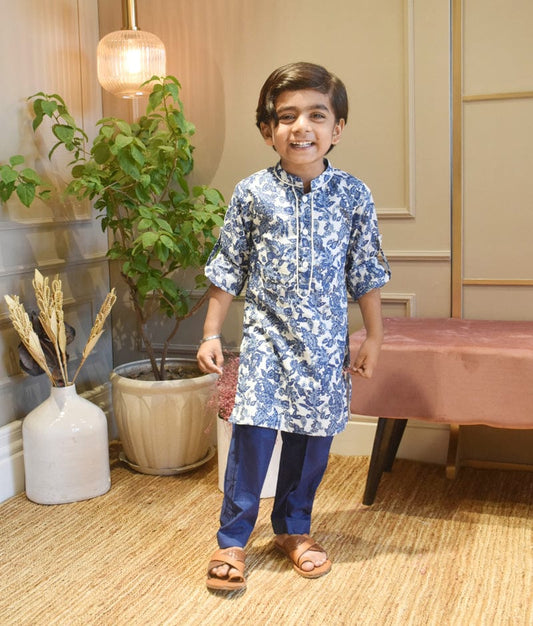
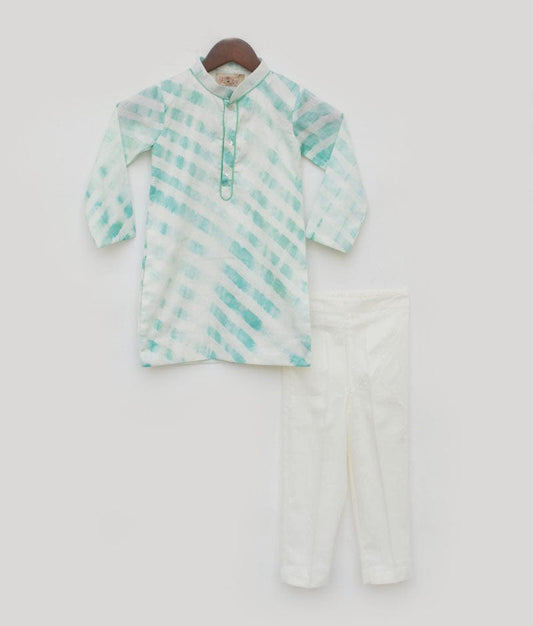
The Simple Cotton Kurta Pyjama is the everyday version. Plain or lightly printed, in breathable cotton, this is what children wear for casual family gatherings, regular pujas, and festivals like Janmashtami or Diwali, where the emphasis is on participation rather than performance. It is comfortable enough to wear through a full day of festivity without causing discomfort.
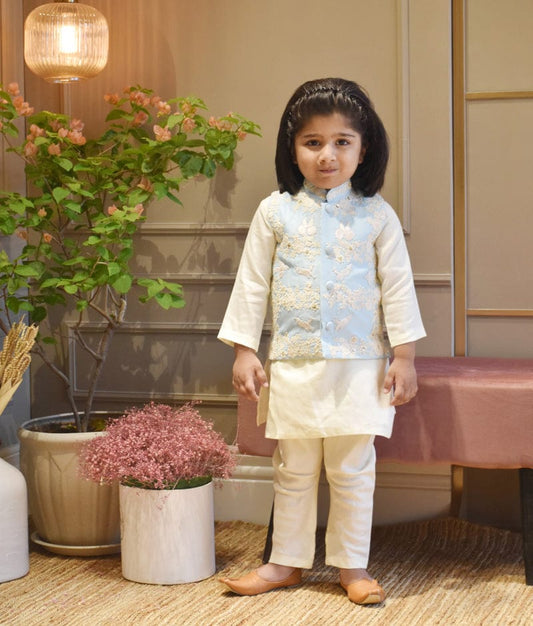
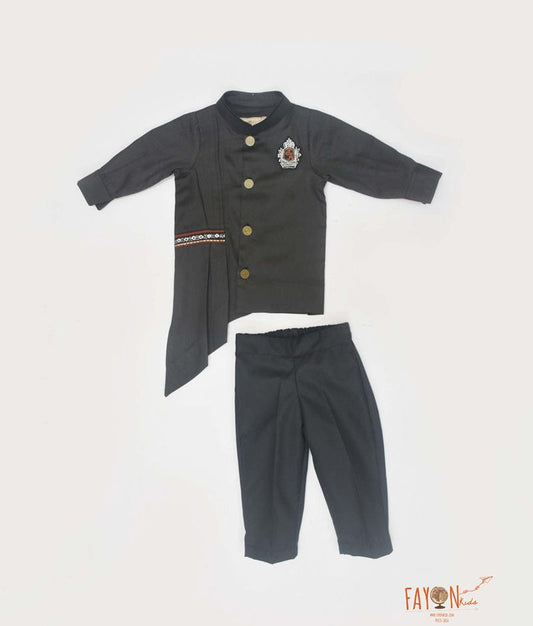
The Embroidered Kurta Pyjama is the festive version. Thread work, mirror embroidery, or zari detailing on the neckline, cuffs, and hem elevates a basic kurta into something genuinely celebratory. This is the style for weddings, engagement functions, and big family milestones.
The Kurta with Churidar replaces the straight pyjama with a fitted churidar that gathers at the ankle. This is a more formal silhouette, typically chosen for older boys at weddings and formal functions.
The Nehru Jacket Kurta Set adds a structured sleeveless jacket (Nehru jacket) over the kurta, creating a layered look that bridges ethnic and semi-formal dressing. This is particularly popular for boys between the ages of eight and fourteen who want something that looks thoughtfully put together.
Choosing the Right Fabric for a Boy's Kurta Pyjama
Fabric choice is even more important for boys' ethnic wear than it is for girls', because boys tend to be more physically active at events and are more sensitive to fabric discomfort.
Cotton remains the safest and most practical choice for all ages and all seasons. A well-woven cotton kurta is breathable, washable, and comfortable for the full duration of any event.
Silk and Art Silk are appropriate for very formal occasions, particularly winter weddings. They look magnificent in photographs and carry embroidery beautifully. However, they are not ideal for warm weather or for very young children.
Linen is an excellent choice for outdoor or summer events. It looks effortlessly sophisticated, wrinkles in a way that reads as intentional, and is extremely breathable.
Rayon and Viscose blends are commonly used in mid-range ethnic wear and offer a good balance of drape and affordability. They are acceptable for casual to semi-formal occasions but may not be the best choice for very active children, as they can trap heat.
Colour Guide for Boys' Kurta Pyjamas
Indian boys' ethnic wear has traditionally leaned toward white, cream, and beige for formal occasions, with brighter colours like royal blue, maroon, mustard, and green for festive events.
Contemporary parents are increasingly drawn to colour blocking and tonal dressing. A kurta in deep burgundy paired with a cream pyjama, for example, is both traditional and visually striking. Similarly, a mustard kurta with a dark green pyjama creates a festive colour combination that photographs beautifully at haldi or mehendi functions.
For weddings where the boy is a close family member (son or nephew of the bride or groom), it is common to coordinate his outfit with the colour scheme of the wedding. Knowing the primary wedding colours in advance allows you to choose a kurta that feels like part of the celebration's visual identity.
Completing the Look: Safa Pagdi for Boys
A kurta pyjama at a wedding is a strong foundation, but it is the accessories that elevate the look from dressed-up to truly celebratory. The most impactful accessory a boy can wear with a kurta pyjama at a wedding is a Safa Pagdi.
The Safa Pagdi Collection at Fayon Kids fills a gap that has long existed in children's ethnic wear. High-quality, authentically crafted Safa Pagdis for young boys are genuinely rare. Most parents either skip the headwear entirely or settle for poorly made options that fall apart within an hour. Fayon Kids' Safa Pagdis are designed to sit comfortably and securely, so boys can enjoy the full event without constantly adjusting their headwear.
Pairing a richly coloured Safa Pagdi with a coordinated kurta pyjama creates a look that makes every little boy feel like the most important person in the room.
Styling the Kurta Pyjama: Age-Specific Tips
For Toddlers (Ages 1 to 4): Keep it simple. A soft cotton kurta in a bright colour with a matching pyjama is ideal. Skip heavy embroidery and opt for printed or lightly embellished pieces. The priority at this age is comfort.
For Young Boys (Ages 5 to 9): This is the age group where embroidery and Nehru jackets start to make sense. Boys in this age range are old enough to appreciate looking dressed up and enjoy the attention that a well-styled ethnic outfit attracts.
For Older Boys (Ages 10 to 14): Older boys can carry richer fabrics and more elaborate styling. Churidar bottoms, structured Nehru jackets, and heavier embroidery all work for this age group. This is also the age where the Safa Pagdi becomes a genuinely exciting addition rather than an imposition.
For girls at the same events, the Girls Lehenga Collection and the Girls Sharara Collection offer coordinated ethnic options so that siblings can be styled together with visual harmony.
Caring for a Boys' Kurta Pyjama
Cotton and linen kurta pyjamas can generally be machine washed on a gentle cycle in cold water. Always turn embroidered pieces inside out before washing to protect the needlework.
Silk and art silk pieces should always be dry cleaned. Never wring silk fabric. Store it folded in a breathable bag, away from direct light, to prevent fading.
Iron kurtas while they are slightly damp for the best results. Always iron embroidered sections from the reverse side to avoid flattening the needlework.
Where to Shop
For girls attending the same events, explore the Princess Collection and the Barbie Gown Collection for styles that complement the boys' ethnic looks beautifully.
FAQs
Q1. What is the best everyday fabric for a boy's kurta pyjama?
Cotton is the safest choice, breathable, washable, and comfortable for all-day wear.
Q2. At what age can a boy wear an embroidered kurta pyjama?
Embroidery and Nehru jackets suit boys aged five and above; toddlers should stick to simple prints.
Q3. What's the difference between a pyjama and a churidar bottom?
A pyjama is straight and relaxed, while a churidar is fitted and gathers at the ankle for a formal look.
Q4. Should I coordinate a boy's outfit with the wedding's colour theme?
Yes, especially if he's a close family member; it creates a cohesive festive look.
Q5. How do I care for an embroidered kurta?
Turn it inside out before washing and iron embroidered sections from the reverse side.
Q6. What accessory elevates a boy's kurta pyjama for weddings?
A Safa Pagdi adds a festive, celebratory finish to the outfit.