



-
Regular price Rs.3,004Sale price Rs.3,004 Regular priceUnit price per
Ships in 5-6 days.
Get it by Sun, Oct 04 – Mon, Oct 05


Janmashtami Dress for Kids: Celebrate Krishna's Birthday in Style
Every year, on the eighth day of the dark fortnight of the Hindu month of Bhadrapada, families across India and the global Indian diaspora celebrate the birth of Lord Krishna. Janmashtami is a festival unlike any other in the Hindu calendar because it centres on a divine childhood: Krishna as a mischievous, joyful, deeply loved child. This gives the occasion a warmth and playfulness that very few other festivals carry, and it makes children, dressed in the right outfit, the natural centre of its celebration.
The Janmashtami dress for kids sits at the intersection of festivity, cultural identity, and genuine fun. It is one of the few occasions in the Indian festival calendar where dressing children in a character-inspired look, specifically inspired by Krishna and Radha, is not just appropriate but actively celebrated. This guide covers every aspect of choosing, planning, and styling a Janmashtami outfit for children of every age.
The Cultural Context Behind Janmashtami Dressing
Understanding why Janmashtami dressing has its own specific aesthetic helps parents make choices that feel authentic rather than arbitrary.
Lord Krishna is depicted in Indian iconography with a peacock feather in his crown, wearing yellow or saffron pitambar silk, carrying a flute, adorned with a vaijayanti mala of flowers, and occasionally smeared with the butter he was famously fond of stealing. These visual elements have become the design vocabulary of Janmashtami dressing for children.
Radha, Krishna's companion, is typically depicted in pink or red, wearing a lehenga and dupatta, adorned with flowers and traditional gold jewellery.
When children are dressed for Janmashtami, these visual references form the foundation. The peacock feather, the flute prop, the pitambar fabric, the flower jewellery, and the specific color associations of blue, yellow, saffron, and pink are all part of the occasion's design language.
Janmashtami Outfit Styles for Boys
Krishna-Inspired Dhoti Kurta Sets
The most traditional Janmashtami look for boys is a dhoti kurta in yellow or saffron silk or chanderi, styled with a peacock feather in the hair and a small flute as a prop. This look is directly drawn from Krishna's iconographic representation and is the most widely recognized Janmashtami outfit for boys at every age.
The dhoti at Janmashtami is typically styled differently from the mundan dhoti: it is often wrapped in a way that mimics Krishna's pitambar, with the fabric tucked and pleated to evoke the deity's traditional silhouette.
For older boys who want something with more structure, a kurta with a structured Nehru collar in yellow or saffron with gold embellishment maintains the Krishna color reference while reading as a more contemporary occasion outfit.
Our boys kurta salwar collection includes kurta sets in occasion-appropriate fabrics and festive colors that serve as excellent bases for a Janmashtami look.
Contemporary Festive Kurta for Older Boys
For boys between eight and fourteen who may resist a full Krishna costume, a well-chosen festive kurta in peacock blue, saffron, or yellow with gold detailing strikes a balance between occasion-appropriate and age-appropriate. The color reference connects the outfit to the festival without requiring full costume dressing.
Janmashtami Outfit Styles for Girls
Radha-Inspired Lehenga Sets
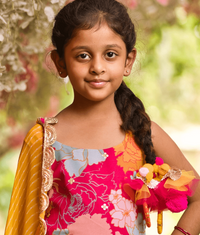
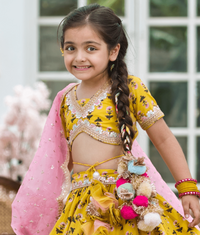
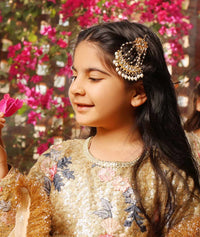
A pink or red lehenga set styled with flower jewellery, a maang tikka, and a dupatta draped over the head is the most traditional Radha-inspired look for girls at Janmashtami. The color palette of pink and gold or red and gold is closely associated with Radha's iconographic depiction and creates a beautiful counterpart to a boy in Krishna's yellow.
Anarkali Suits in Festive Colors
For younger girls or those who find lehenga management difficult during an active festival night, an anarkali in peacock blue, bright pink, or warm orange is a strong alternative. The full-length flared silhouette is graceful in movement and suits the energetic, musical character of the Janmashtami celebration.
Our kids' ethnic wear collection includes girls' festive wear in the colors and fabrics that work naturally for Janmashtami dressing, including options in peacock blue and vibrant pink.
Coordinated Krishna-Radha Looks for Brother-Sister Pairs
One of the most beloved Janmashtami traditions in Indian families is dressing a brother and sister as Krishna and Radha. The boy in a yellow or saffron dhoti kurta with a peacock feather and the girl in pink or red lehenga with flower jewellery create a look that is culturally rooted, visually stunning, and genuinely joyful.
The Janmashtami Color Guide for Kids
|
Color |
Association |
Best Outfit Application |
|
Yellow and Saffron |
Krishna's pitambar, divine energy |
Boys' dhoti kurta, kurta sets |
|
Pink and Fuchsia |
Radha's traditional depiction |
Girls' lehenga, anarkali |
|
Peacock Blue |
Krishna's skin color in iconography |
Boys' and girls' festive kurtas |
|
Red and Gold |
Festivity, auspiciousness |
Girls' lehenga, anarkali |
|
Turquoise |
Reminiscent of Krishna's flute |
Contemporary fusion options |
|
White with Gold |
Purity, spiritual occasion |
Simpler, more restrained looks |
Janmashtami Accessories: The Details That Make the Difference
Accessories are where Janmashtami dressing becomes genuinely distinctive from other festive occasions.
For boys styled as Krishna:
- A peacock feather is placed in the hair or attached to a small mukut crown
- Vaijayanti mala: a garland of white or mixed flowers or a fabric replica
- Small flute as a prop for photographs
- Kangan or bangles on the wrists
For girls styled as Radha:
- Fresh or fabric flowers woven into the hair or arranged as a crown
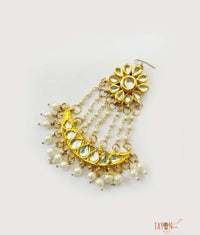
- Maang tikka in gold
- Flower jewellery made from jasmine or marigolds for authentic styling
- Bindi in a traditional shape
For broader festive occasion wear reference, our pret wedding collection demonstrates the fabric quality and design approach that Fayon Kids applies to celebration dressing across different festival categories.
Fabric and Comfort for Janmashtami
Janmashtami falls in late August or early September, still within the tail end of the monsoon season. Fabric choices must account for warmth and humidity.
Best fabrics for Janmashtami outfits:
- Chanderi in yellow or saffron: lightweight, luminous, and perfectly suited to the Krishna color palette
- Soft cotton silk in festive colors: breathable and festive
- Georgette for girls' dupattas and anarkali overlays: flowy and comfortable
- Soft tissue silk as an accent: adds sheen without adding weight
Fabrics to avoid:
- Heavy velvet or thick Banarasi as the primary fabric
- Dense brocade without breathable lining
- Stiff taffeta that restricts movement
Ready to dress your child for Janmashtami? Contact Fayon Kids and let us help you create a custom festive outfit in the right color, fabric, and size for your child.
Frequently Asked Questions
Q1: Is it necessary to dress children in Krishna or Radha costumes for Janmashtami?
No. While Krishna and Radha-inspired looks are the most traditional choice, simply dressing children in festive ethnic wear in the occasion's signature colors (yellow, saffron, pink, or peacock blue) is equally appropriate.
Q2: What is the most popular Janmashtami outfit for boys?
A yellow or saffron dhoti kurta styled with a peacock feather and a small flute prop is the most widely observed and most photographed Janmashtami look for boys across all age groups.
Q3: Can girls be styled as Krishna instead of Radha?
Yes. Many families dress their daughters in the Krishna look, particularly when there is no brother to pair with or when the girl specifically prefers it. A blue or yellow dhoti kurta styled with a peacock feather works beautifully for girls as well.
Q4: What age groups are most suited to full Krishna-Radha costume dressing?
Full costume dressing with accessories like peacock feathers, flower garlands, and props works best for children between two and ten years. Older children often prefer the festive color palette and embellishment style without the full costume elements.
Q5: How much lead time is needed for a custom Janmashtami outfit?
We recommend four to five weeks for a standard custom order. If you are planning a coordinated sibling set with matched design elements, six weeks gives a more comfortable production timeline.
Q6: Does Fayon Kids offer custom-made Janmashtami outfits for infants?
Yes. Janmashtami outfits for babies and very young children are available and made to the infant's actual measurements, with soft lining and appropriate construction for young skin.