




-
Regular price Rs.10,787Sale price Rs.10,787 Regular priceUnit price per
Ships in 5-6 days.
Get it by Sun, Oct 04 – Mon, Oct 05
-
Regular price Rs.11,395Sale price Rs.11,395 Regular priceUnit price per
Ships in 2-3 days.
Get it by Fri, Oct 02 – Sun, Oct 04
-
Regular price Rs.6,760Sale price Rs.6,760 Regular priceUnit price per
Ships in 5-6 days.
Get it by Sun, Oct 04 – Mon, Oct 05
-
Regular price Rs.7,082Sale price Rs.7,082 Regular priceUnit price per
Ships in 5-6 days.
Get it by Sun, Oct 04 – Mon, Oct 05
-
Regular price Rs.9,335Sale price Rs.9,335 Regular priceUnit price per
Ships in 5-6 days.
Get it by Sun, Oct 04 – Mon, Oct 05
-
Regular price Rs.11,374Sale price Rs.11,374 Regular priceUnit price per
Ships in 5-6 days.
Get it by Sun, Oct 04 – Mon, Oct 05
-
Regular price Rs.11,234Sale price Rs.11,234 Regular priceUnit price per
Ships in 2-3 days.
Get it by Fri, Oct 02 – Sun, Oct 04
-
Regular price Rs.7,986Sale price Rs.7,986 Regular priceUnit price per
Ships in 5-6 days.
Get it by Sun, Oct 04 – Mon, Oct 05
-
Regular price Rs.7,596Sale price Rs.7,596 Regular priceUnit price per
Rs.10,690Ships in 5-6 days.
Get it by Sun, Oct 04 – Mon, Oct 05
Sale -
Regular price Rs.10,787Sale price Rs.10,787 Regular priceUnit price per
Ships in 5-6 days.
Get it by Sun, Oct 04 – Mon, Oct 05
-
Regular price Rs.8,048Sale price Rs.8,048 Regular priceUnit price per
Ships in 5-6 days.
Get it by Sun, Oct 04 – Mon, Oct 05
-
Regular price Rs.9,013Sale price Rs.9,013 Regular priceUnit price per
Ships in 5-6 days.
Get it by Sun, Oct 04 – Mon, Oct 05
-
Regular price Rs.9,013Sale price Rs.9,013 Regular priceUnit price per
Ships in 5-6 days.
Get it by Sun, Oct 04 – Mon, Oct 05
-
Regular price Rs.9,013Sale price Rs.9,013 Regular priceUnit price per
Ships in 5-6 days.
Get it by Sun, Oct 04 – Mon, Oct 05
-
Regular price Rs.8,643Sale price Rs.8,643 Regular priceUnit price per
Ships in 5-6 days.
Get it by Sun, Oct 04 – Mon, Oct 05
-
Regular price Rs.8,643Sale price Rs.8,643 Regular priceUnit price per
Ships in 5-6 days.
Get it by Sun, Oct 04 – Mon, Oct 05
-
Regular price Rs.8,874Sale price Rs.8,874 Regular priceUnit price per
Ships in 5-6 days.
Get it by Sun, Oct 04 – Mon, Oct 05
-
Regular price Rs.11,559Sale price Rs.11,559 Regular priceUnit price per
Ships in 5-6 days.
Get it by Sun, Oct 04 – Mon, Oct 05
-
Regular price Rs.7,214Sale price Rs.7,214 Regular priceUnit price per
Ships in 5-6 days.
Get it by Sun, Oct 04 – Mon, Oct 05
-
Regular price Rs.8,083Sale price Rs.8,083 Regular priceUnit price per
Ships in 5-6 days.
Get it by Sun, Oct 04 – Mon, Oct 05
-
Regular price Rs.10,690Sale price Rs.10,690 Regular priceUnit price per
Ships in 5-6 days.
Get it by Sun, Oct 04 – Mon, Oct 05
-
Regular price Rs.19,092Sale price Rs.19,092 Regular priceUnit price per
Ships in 5-6 days.
Get it by Sun, Oct 04 – Mon, Oct 05
-
Regular price Rs.17,383Sale price Rs.17,383 Regular priceUnit price per
Ships in 5-6 days.
Get it by Sun, Oct 04 – Mon, Oct 05
-
Regular price Rs.8,083Sale price Rs.8,083 Regular priceUnit price per
Ships in 5-6 days.
Get it by Sun, Oct 04 – Mon, Oct 05


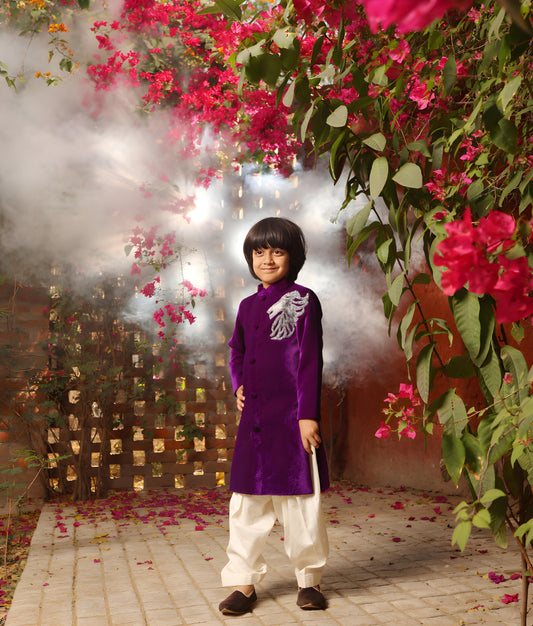


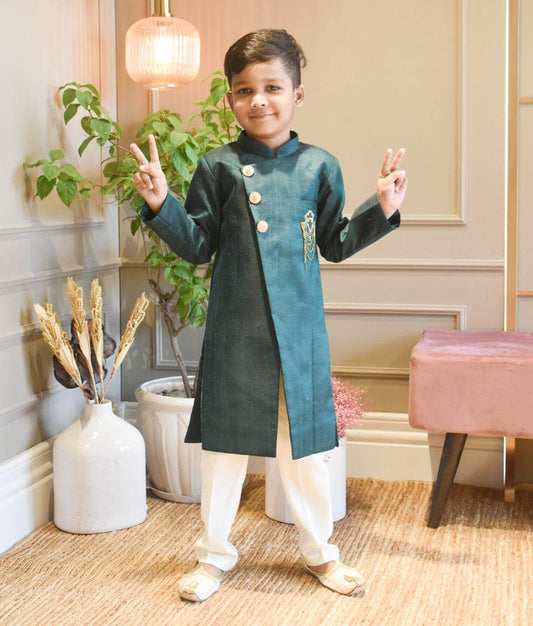

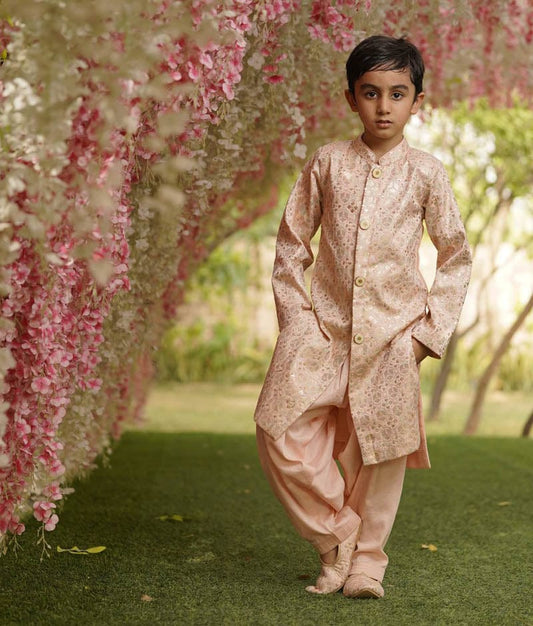

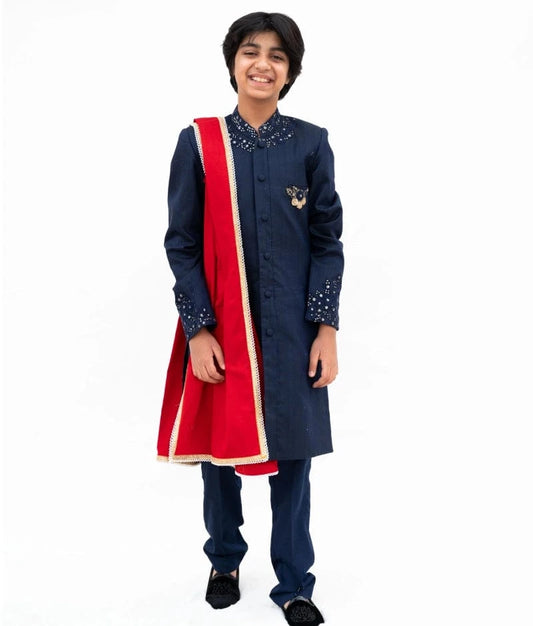


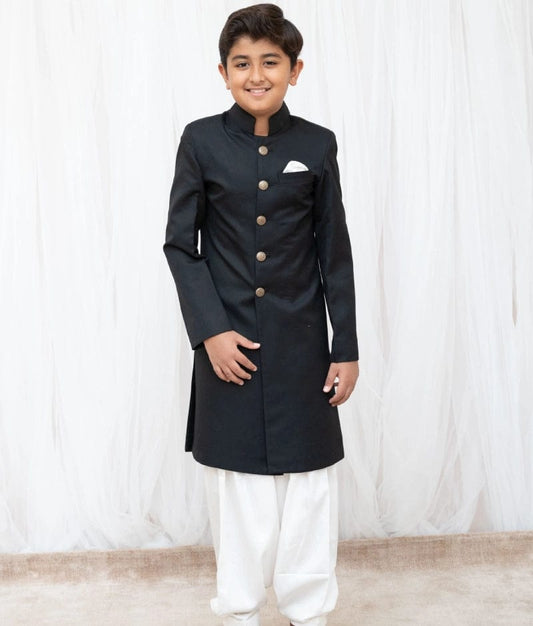


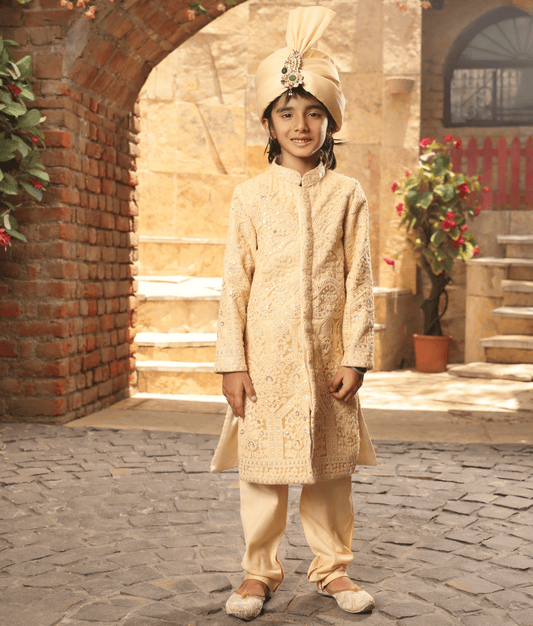


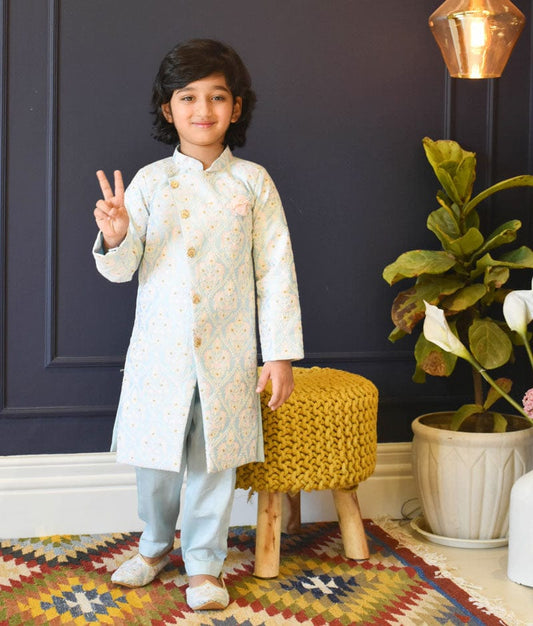


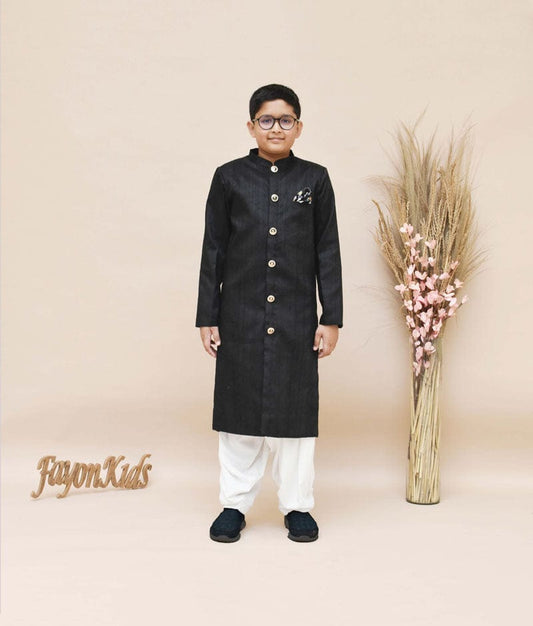

Kids Sherwani for Boys Online: How to Choose the Right One Without Getting It Wrong
Buying a kids sherwani for boys online is one of those purchases where the gap between what you see on screen and what arrives at your door can be genuinely disappointing. This is not unique to sherwanis, but it is more pronounced with them than with most other children's garments, because a sherwani's quality is defined by things that do not photograph easily: the weight of the fabric, the crispness of the collar, the precision of the embroidery, and above all, the accuracy of the fit.
This piece is written as a practical buying guide. It covers what to look for, what questions to ask, how to measure correctly, which styles suit which occasions, and why the custom-made route consistently produces better results than standard sizing for a garment where fit is everything.
What Makes a Kids Sherwani Different from a Regular Kurta
Before getting into the buying guide, it is worth understanding what actually defines a sherwani versus a kurta, because the two are frequently confused online.
A sherwani is:
- Longer than a kurta, typically falling below the knee to mid-calf
- More structured, with a more tailored fit through the chest and shoulders
- Usually made in richer fabrics: silk, velvet, brocade, or structured chanderi
- Worn with a churidar or slim pyjama rather than a loose pyjama
- Often buttoned from collar to hem rather than having a simple front pleat
A kurta is:
- Shorter, typically falling to mid-thigh or the knee
- Less structured, with a more relaxed fit
- Made in a wider range of fabrics from daily cotton to occasion silk
- Worn with a variety of bottoms, including dhoti, pyjama, and churidar
The distinction matters when shopping online because many listings blur these categories. A garment labelled as a sherwani but constructed with a kurta-level structure will not deliver the sherwani's signature look, regardless of what the product page says.
The Four Most Important Factors When Buying a Kids Sherwani Online
Factor 1: Fabric Quality and Specification
The fabric of a sherwani determines its drape, its structure, its appearance in photographs, and its comfort over a long event. When buying online, look for specific fabric descriptions rather than generic terms.
Terms to look for:
- Specific fabric names: raw silk, dupion silk, velvet, brocade, chanderi
- Inner lining specification: what is the lining material, and is it mentioned at all
- Embellishment description: zardozi, resham, thread work, stone, or sequin
Terms that are red flags:
- "Silk-like fabric" or "silk feel" without specifying the actual material
- "High quality" without further specification
- "Premium fabric" with no further detail
Factor 2: Fit and Sizing
This is the single most critical factor for a sherwani, and the one most affected by the online buying context.
Standard size charts for children's sherwanis online are based on age, which is the least reliable sizing guide for any child. Two eight-year-olds can have completely different chest measurements, shoulder widths, and torso lengths. A sherwani that fits perfectly on one will look entirely wrong on the other, even if both are size eight according to the chart.
What to do instead:
- Always measure before ordering: chest circumference, shoulder width, torso length from shoulder to desired hem, and waist circumference
- Look for brands that allow measurement-based sizing rather than age-based sizing only
- Choose custom-made over ready-made whenever possible for a garment where fit is critical
Our boys achkan collection is custom-made to each boy's actual measurements, which means the structure and fit of the garment is built for his specific body rather than an age-group average.
Factor 3: Construction Quality
The construction of a sherwani is what determines whether it maintains its structure through a long wedding or festival event. Key construction quality indicators:
- Collar construction: A sherwani collar should be stiff enough to hold its shape but not so stiff that it is uncomfortable. Look for mandarin or band collars with the interfacing mentioned.
- Button quality: Sherwanis use buttons from the collar to the hem. These need to be secure, correctly spaced, and made in a material appropriate to the fabric weight.
- Seam finishing: Inside seams on a boy's sherwani should be finished cleanly because young boys are active and the seams experience real stress during wear.
- Embellishment security: Any embroidery or embellishment should be tightly secured to the fabric with no loose threads or elements that could detach.
Factor 4: Return and Exchange Policy
When buying kids sherwani online, a clear and fair return or exchange policy is non-negotiable. Fit issues with children's occasion wear are common, particularly for a garment as structure-dependent as a sherwani. Before placing an order, confirm:
- Whether returns are accepted for fit issues
- What is the timeline for returns or exchanges
- Whether custom or made-to-measure orders have different policies
Which Sherwani Style Suits Which Occasion
Not all sherwanis are created equal for all occasions. Choosing the right style for the right event is as important as choosing the right size.
|
Occasion |
Recommended Sherwani Style |
Fabric Choice |
|
Wedding Ceremony |
Full-length, heavily embroidered |
Silk, brocade, velvet for winter |
|
Reception |
Full-length or knee-length with embellishment |
Raw silk, dupion silk |
|
Sangeet |
Shorter sherwani or kurta-sherwani hybrid |
Chanderi, printed silk |
|
Festival (Diwali, Eid) |
Mid-length with moderate embellishment |
Silk, chanderi |
|
Birthday Party |
Knee-length, lighter embellishment |
Cotton silk, chanderi |
|
Naming Ceremony |
Simple, soft construction |
Chanderi, cotton silk |
How to Measure Your Boy for an Online Sherwani Order
Taking accurate measurements at home is straightforward if you follow these steps in the right order.
Step 1: Chest measurement Measure around the fullest part of the chest with the child standing naturally. Keep the tape parallel to the floor and do not pull it tight. Add one inch to the actual measurement for ease of movement.
Step 2: Shoulder width Measure from the edge of one shoulder to the edge of the other across the back. This is one of the most critical measurements for a sherwani because the shoulder seam placement determines the entire look of the garment.
Step 3: Torso length Measure from the top of the shoulder to the desired hem length. For a full-length sherwani, this is typically to mid-calf. For a shorter style, to just below the knee.
Step 4: Waist circumference Measure around the natural waist. For a sherwani, this determines the taper through the body.
Step 5: Sleeve length Measure from the shoulder seam to the wrist with the arm slightly bent. A sherwani sleeve should end exactly at the wrist.
For broader boys' occasion wear that follows these same measurement principles, our kids' ethnic wear collection demonstrates the range of styles available for boys across different age groups and occasions.
Color Guide for Kids' Sherwanis
Color choice for a boy's sherwani is driven by occasion, season, and the family's overall coordination plan.
Sherwanis that work across multiple occasions:
- Ivory and gold: wedding-appropriate, timeless, photographs richly
- Navy and gold: sharp and formal, works for ceremonies and receptions
- Maroon and gold: deeply festive, traditional wedding palette
- Bottle green and gold: contemporary, increasingly popular
- Beige and silver: a lighter alternative to ivory, suits summer weddings
Sherwanis for specific occasions:
- Saffron or yellow for Janmashtami or Navratri
- Pastel mint or blue for Eid celebrations
- Rich red or maroon for Diwali evening events
Why Custom-Made Beats Standard Sizing for a Kids Sherwani
The argument for custom-made sherwanis for boys comes down to one simple fact: the garment's entire visual impact depends on fit, and standard sizing cannot reliably deliver accurate fit for children whose proportions vary as much as they do.
A custom-made sherwani built to a boy's actual measurements will:
- Sit correctly at the shoulders
- Fall at the exact right length for his torso
- Have sleeves that end precisely at his wrist
- Taper through the body in proportion to his actual waist and chest
None of these outcomes can be reliably guaranteed from a standard size chart.
For wedding occasion wear across the full range of boys' styles, our wedding dress for kids collection covers the complete spectrum of boys' and girls' occasion wear for different wedding functions.
Ready to order a custom kids sherwani for your boy online? Contact Fayon Kids with his measurements and occasion details today.
Frequently Asked Questions
Q1: What is the difference between a sherwani and an achkan?
A sherwani is a long coat-like garment typically worn for formal occasions with a churidar. An achkan is similar in length and silhouette but is generally less embellished and has a slightly different cut through the body. Both are formal ethnic wear for boys, and the terms are sometimes used interchangeably.
Q2: At what age can a boy start wearing a full-length sherwani?
A full-length sherwani works from approximately two years old onwards. For younger babies, a shorter sherwani-style kurta or a dhoti kurta set is more practical and equally appropriate for the occasion.
Q3: How do I know if a sherwani I ordered online will fit correctly?
The most reliable approach is to order from a brand that offers custom or measurement-based sizing rather than age-based sizing. Standard age charts for sherwanis are unreliable because children of the same age vary significantly in their proportions.
Q4: Can a boy's sherwani be altered after delivery if the fit is not perfect?
Minor alterations such as hem length and sleeve length adjustments are possible on most sherwanis. However, significant structural alterations like shoulder width changes are much more difficult and may affect the garment's overall appearance.
Q5: What should a boy wear with a sherwani?
A sherwani is traditionally worn with a churidar, a slim-fitting trouser that gathers at the ankle, and mojris or ethnic footwear. A dupatta or stole is sometimes added for wedding ceremonies.
Q6: How far in advance should I order a custom boys sherwani online?
We recommend placing custom sherwani orders at least four to six weeks before the occasion. For wedding season orders between October and March, placing the order earlier is advisable, given peak demand.